Moving to enforcement Step 11 of 35
The 30-day review: moving to p=reject
Reject waits for 30 days of reports, 98% passing and a month at enforced quarantine. What the adviser checks, and how to take the final step safely.
Updated
p=reject asks receivers to refuse mail that fails DMARC outright. It’s the
policy that actually stops someone sending as your domain, and because
rejected mail is gone rather than sitting in a junk folder, the adviser asks
for more evidence before it recommends it.
What the adviser needs
The domain must be enforcing p=quarantine (with t=y removed). Then:
| Check | Test quarantine | Enforce quarantine | Test reject | Enforce reject |
|---|---|---|---|---|
| Days of reports | at least 14 | at least 30 | at least 30 | at least 30 |
| Messages observed | at least 100 | at least 100 | at least 500 | at least 500 |
| Mail passing DMARC | at least 95% | at least 95% | at least 98% | at least 98% |
| Persistent failing sources | none | none | none | none |
| Time at the previous step | 30 days at enforced quarantine | 7 days testing reject |
As before, days are days covered by reports in the last 90; the pass rate and failing sources are judged over the last 30 days; and a source that keeps failing blocks the step by name.
Days at enforced quarantine is a separate clock. It starts the first day
the adviser sees your record at p=quarantine without t=y. Reject can’t be
quietly undone (a refused message never reaches anyone’s junk folder), so the
adviser waits for a month of quarantine actually acting on your mail. Anything
someone finds in their junk folder in that month is a sender to fix while it’s
still recoverable. Until then, What’s in the way shows, for example,
“12 of 30 days at p=quarantine”.
The adviser’s numbers are minimums. If you have quarterly senders, such as a quarterly newsletter or a tax run, give it 60 to 90 days of reports.
Before you take the step
Look at the domain’s Sources once more:
- Known sender, failing and Unknown or threat: anything of yours still failing will be refused.
- Sources that pass on SPF aligned but not DKIM aligned. That mail
passes today but fails when it’s forwarded, and at
p=rejectforwarded mail that fails is refused. Where the service supports DKIM, turn it on. - Anything new. A sender added since you moved to quarantine has had less time in the reports. The adviser also emails a New sending source alert when one appears.
When the checks pass, the panel says Ready to test p=reject.
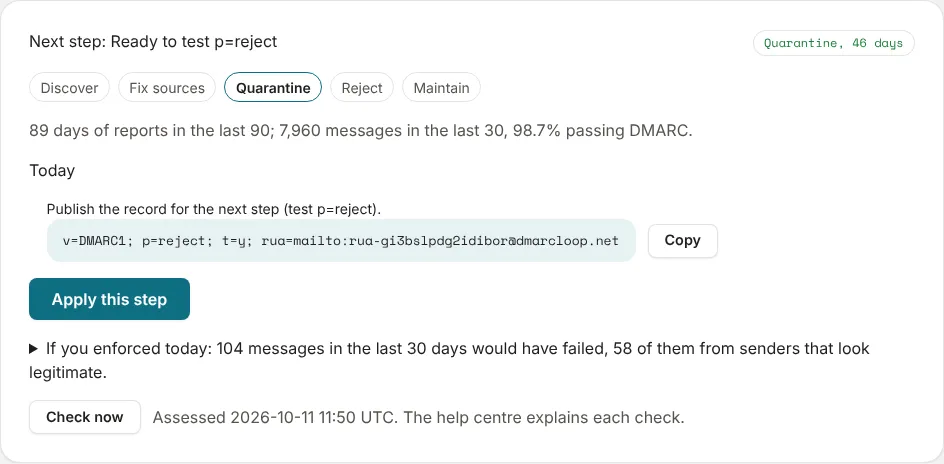
If you enforced today shows what reject would have refused over the last 30 days. Forwarded mail from mailing lists is usually most of it; see Identify your sending sources.
Test, then enforce
The same two-step change as quarantine:
-
Publish
p=rejectwitht=y, keeping everything else. In test mode, receivers treat it asp=quarantine:v=DMARC1; p=reject; t=y; rua=mailto:rua-…@dmarcloop.net -
Leave it at least seven days. The panel shows “3 of 7 days testing p=reject” until then, and Ready to enforce p=reject when the evidence holds.
-
Remove
t=y:v=DMARC1; p=reject; rua=mailto:rua-…@dmarcloop.net
With hosted DMARC, Apply this step makes each change; with a self-managed record, edit it at your DNS host and choose Check now. The panel then reads Fully enforcing, and the domain moves to Maintain.
If your record has an sp= tag (the policy for subdomains) or an np= tag
(subdomains that don’t exist), check those too: a domain at p=reject with
sp=none still leaves its subdomains open. In the DMARC editor they are
Subdomains (sp) and Subdomains that don’t exist (np).
Next
Stuck? Reply to any email DMARCLoop sends, or contact us — a person reads it.